
RKV379P-DVB-T-4.0

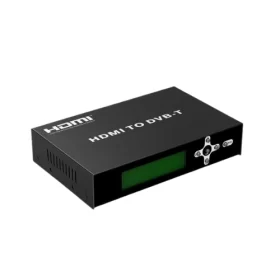
HDMI To DVB Converter

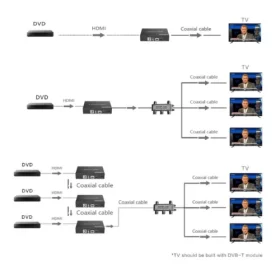
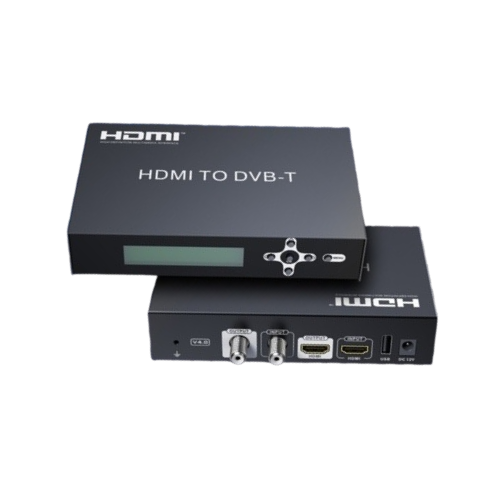
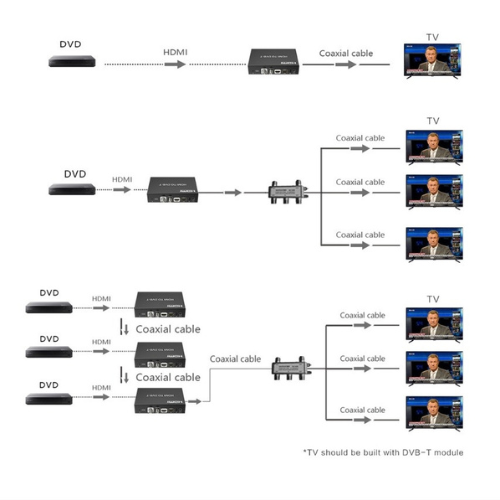
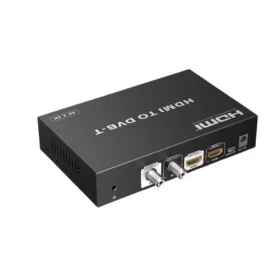
Thisis anHDMI™ to DVB-T Converter, perfect solutionto distribute HDMI™ signal to DVB-T1 standard digital cable television via coaxial cables. Output can be set as any channel number and distributed to all the TV’S in the system directly via CATV splitter

Product Overview

The product shown is an HDMI to DVB‐T Converter designed to take an HDMI signal from a source device and convert it into a DVB‐T digital TV signal that can be distributed over coaxial cables to multiple televisions. It supports HDMI 1.3 with full HDCP1.2 compatibility and handles HDMI TMDS signals from 0.5–1.5 Vpp, while using a 5 Vpp TTL HDMI DDC signal for communication. The converter operates with input HDMI resolutions from standard definition 480p and 576p up to 720p and 1080p at a variety of frame rates, making it suitable for most modern media players and set‐top boxes. Video is encoded in H.264 format, audio is encoded using MPEG‐2 and output as stereo PCM at 44.1 kbit/s or 48 kbit/s, ensuring good quality audiovisual transmission over the DVB‐T standard.

Signal and broadcasting parameters

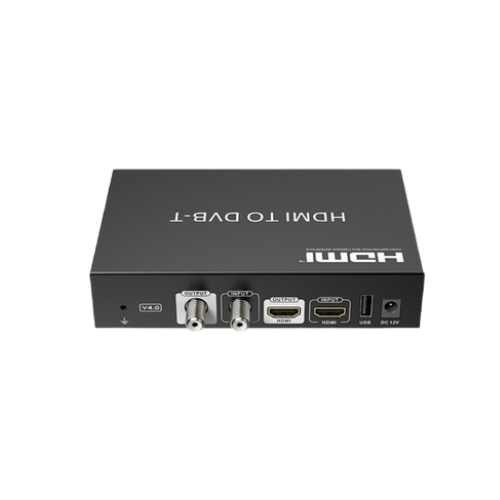
The converteroutputs a DVB‐T standardRF signal over coaxialcables, using typical broadcast coax types such as RG6, RG7, or RG11, and supports a working frequency range from 177.5 MHz to 866 MHz. It offers an effective bit‐rate of up to 24 Mbit/s, with RF output power adjustable between about −40 dBm and −13 dBm, and an insertion loss of around 0 dBm, which helps maintain signal quality in distribution systems. The RF interface follows the British 75‐ohm F‐type connector standard, allowing easy integration with existing CATV splitters and TV tuners. 
Download Brochure

Category:

Product Description

Performance and latency

Thedevice isdesigned forstableoperation inprofessionalorhome distribution setups, with typical end‐to‐end delay in the range of 200–300 ms, depending on the decoding performance of the receiving TVs or set‐top boxes. This latency is acceptable for most broadcasting and monitoring applications where real‐time interactivity is not critical, such as feeding HDMI output from media players, satellite receivers, or information display systems into a coaxial network.

Power, environment, and physical details

Powerissupplied by a DC 12V / 1 A adapter, and the unit consumes less than 7 W,making itenergy‐efficient for continuous 24/7 operation. It is specified to work in ambient temperatures from approximately −20 °C to +60 °C, with storage temperatures from about −30 °C to +70 °C and relative humidity from 0–90% without condensation, which suits a range of indoor environments including equipment rooms and control cabinets. The enclosure is a compact black box measuring roughly 158 × 114.3 × 33 mm and weighing around 520 g, so it can be easily mounted on shelves or within racks as part of a larger distribution system. 

Specifications

HDMI input signal: HDMI 1.3, fully compatible with HDCP 1.2. HDMI DDC signal level: 5 Vp‐p (TTL). HDMI TMDS signal level: 0.5–1.5 Vp‐p (TMDS). Supported HDMI resolutions: 480i@60 Hz, 480p@60 Hz, 576i@50 Hz, 576p@50 Hz, 720p@50/60 Hz, 1080i@50/60 Hz, 1080p@24/25/30/50/60 Hz. Video encoding format: H.264. Audio encoding format: MPEG‐2. Output standard over coaxial: DVB‐T. Recommended coaxial cable types: RG6, RG7, RG11. RF frequency range: 177.5 MHz to 866 MHz. Maximum effective bitrate: 24 Mbit/s. Insertion loss: 0 dBm. RF output power (TX): −40 dBm to −13 dBm. RF interface: British system 75 Ω F‐type connector. Typical delay time: 200–300 ms (depends on decoder in receiver). Audio output format: Stereo PCM (44.1 kbps, 48 kbps). Power supply requirement: DC 12 V / 1 A. Power consumption: less than 7 W.

Effortless Installation and Use

The splitteris designedfor easyinstallationand operation, with a simpleplug-and-play setup that requires no software or drivers . The user manual provides clear connectiondiagrams and instructions to guide you through the process . To get started, you simply connect your HDMI source to the input port and your displays to the output ports .